The Next 12 Months: Simpler, Smarter, Everywhere

A roadmap for building the intelligent DeFi portfolio layer Q2 2026 – Q2 2027
Where Levva Stands Today
Levva is live on Ethereum mainnet with four risk-tiered DeFi portfolio vaults, each allocating capital across battle-tested protocols. Our current deployment looks like this:
Ultra-Safe: Equal allocation across Aave v3 USDC, Gauntlet USDC Prime (Morpho), and Tokemak autoUSDC. Pure stablecoin lending yield, no volatile asset exposure. Current APY range: 2–6%.
Safe: 90% stablecoin yield (split evenly between Aave v3 USDC and Morpho’s Gauntlet USDC Balanced vault) with 10% volatile exposure through Tokemak autoETH. Annualized target: 5–7%.
Brave: 70% stablecoin yield (Aave v3 USDC + Morpho’s Gauntlet USDC Frontier) and 30% volatile allocation split between Tokemak autoETH (15%) and direct WBTC holdings (15%). Target: 10–16%.
Custom WETH: Full ETH exposure through Origin’s stETH ARM and Tokemak autoETH in a 50/50 split.
On the AI side, LevvAI currently runs on ElizaOS and is integrated with Virtuals Protocol. It provides a Pendle MCP (Model Context Protocol) tool that can buy and sell PT tokens and manage LP positions on Pendle. This was a useful first step, but we’ll be honest: the current agent architecture is limited. Eliza V1 served its purpose as a proof of concept, but it cannot scale to the autonomous portfolio management system we need.
Our planned asset universe is broad — Ethena (sUSDe), Resolv (wstUSR), Sky.money (USDS), Pendle yield tokenization, Euler lending, Curve and Uniswap stable AMM liquidity, Origin (wOETH), Etherfi (weETH, eBTC), and Lido (wstETH) — but most of these integrations remain on the drawing board. The spreadsheet exists; the adapters mostly don’t.
This roadmap is about closing that gap. Not by adding complexity, but by ruthlessly simplifying the architecture while expanding what it can do.
What Changed in DeFi While We Were Building

The DeFi landscape restructured around three themes that directly shape our roadmap:
The Modular Vault Revolution
Protocols like Morpho, Euler V2, and Fluid decoupled lending from curation. Morpho Blue now holds over $10 billion with 30+ professional curators managing MetaMorpho vaults. Euler V2’s Ethereum Vault Connector allows any vault to accept deposits from any other vault as collateral. Fluid generates up to $39 in liquidity per dollar of TVL through a unified lending-borrowing-DEX layer. The takeaway: the protocol layer is solved infrastructure. The value accrues to whoever curates it best.
Hyperliquid Became the Derivatives Standard
Hyperliquid processed $2.95 trillion in volume through 2025 and launched HyperEVM — a full EVM embedded within its L1 that can read order book data and place orders through precompiles. Portfolio margin (testnet December 2025) nets hedged positions for 30%+ lower margin requirements. For vault protocols, this means ERC-4626 vaults can now trade directly on the deepest on-chain order book. Projects like Liminal already run delta-neutral strategies at 15–20% APY.
AI Agents Moved from Hype to Infrastructure
Giza Protocol’s ARMA deployed 25,000+ agents managing $35M+ in capital on Base. Olas agents became the largest user category on Gnosis Chain. Theoriq introduced “policy cages” — smart contract rules precisely defining what an agent can and cannot do. But the “February Wick” wiped $400 million in 3 seconds when 15,000 agents using similar models all tried to exit the same pool. The lesson: AI autonomy needs guardrails, not just capabilities.
Onboarding Hit Fintech Grade
EIP-7702 (live since Ethereum’s Pectra upgrade, May 2025) lets any MetaMask user get smart wallet features without deploying new contracts. ZeroDev has 6 million+ smart accounts. Biconomy’s Supertransactions execute multi-step, multi-chain operations with a single signature. Coinbase offers zero-fee USDC on-ramps on Base. The user experience gap between DeFi and traditional finance is closing fast.
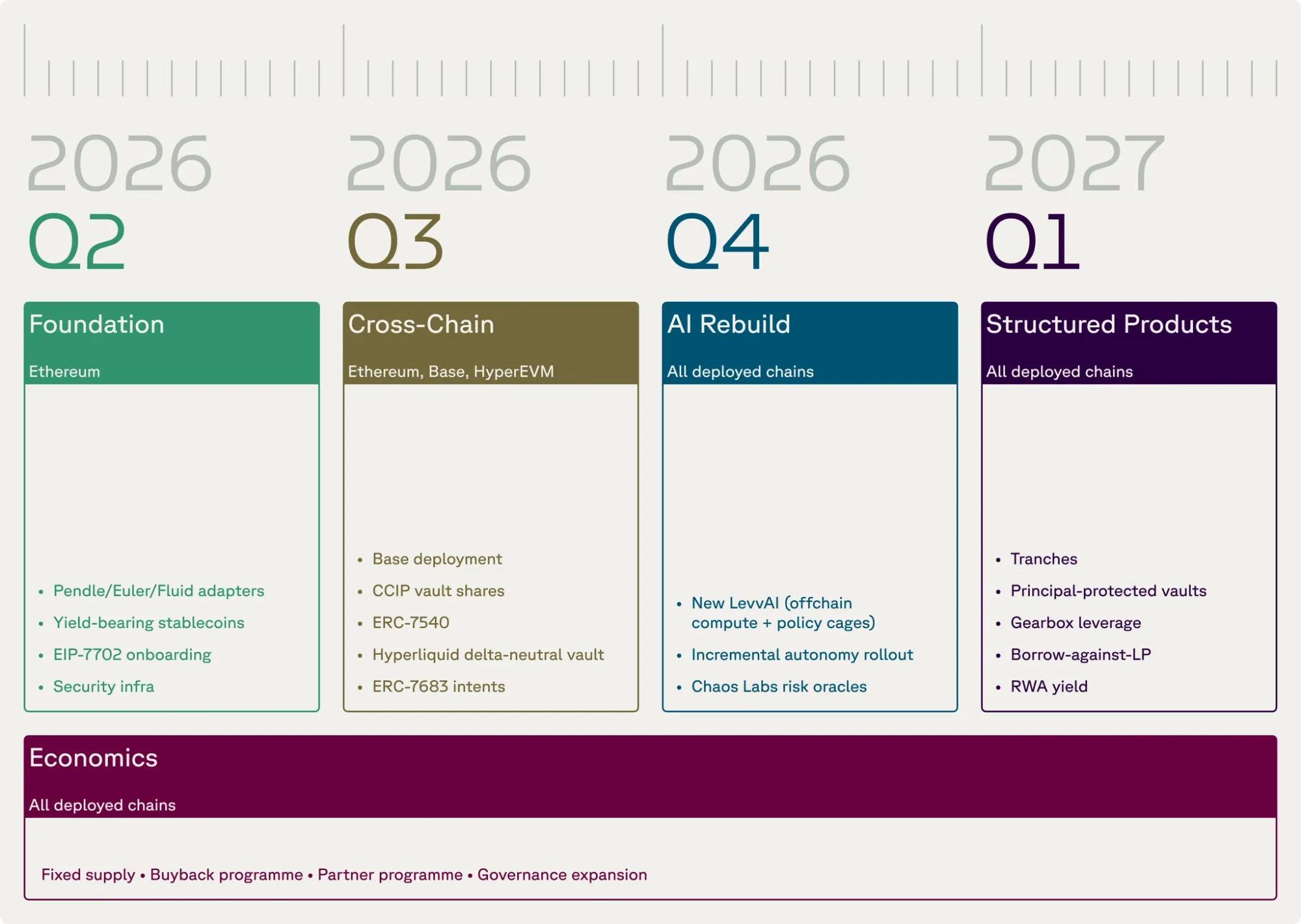
The Roadmap: Four Phases, Twelve Months

Phase 1: Harden the Foundation (Months 1–3)
Theme: Ship the adapters, simplify the stack, prepare for scale.
Complete the Adapter Matrix
Our vault allocations spreadsheet lists protocols we plan to support. Phase 1 turns that spreadsheet into production code:
- Pendle PT adapter upgrade. We already have a working Pendle adapter for PT swaps. In Phase 1 we extend it to support Pendle’s full Boros product (margin-enabled funding rate trading) and add adapters for sUSDe, wstUSR, and USDS PT maturities. Fixed-rate Pendle PTs will become the backbone of Ultra-Safe yield — effectively on-chain zero-coupon bonds.
- Euler V2 integration. Deploy an Euler Vault Connector adapter so Levva vault shares can be recognized as collateral within Euler’s ecosystem. This unlocks capital efficiency: a user holding Ultra-Safe vault shares can borrow against them on Euler without withdrawing.
- Fluid Smart Collateral adapter. Fluid’s architecture lets LP positions serve as lending collateral while still earning DEX fees. We’ll integrate this for the Brave tier to stack yield sources.
- Yield-bearing stablecoin support. Add sUSDe (Ethena), sUSDS (Sky.money), and wstUSR (Resolv) as base assets for the Safe Yield allocation. These yield-bearing stablecoins have become core DeFi collateral and offer 4–15% APY on their own.
Simplify Onboarding
We will deploy a modern onboarding stack that eliminates every friction point:
- EIP-7702 support. All vault interactions will work with 7702-delegated EOAs, enabling batched approve+deposit in a single transaction with gas sponsorship for first-time users. No new wallet deployment required.
- Coinbase Onramp integration. Zero-fee USDC purchases on Base, directly into Levva vaults. Credit card to vault deposit in under 60 seconds.
- Embedded wallet option. Via Privy or ZeroDev — sign in with Google or email, get an instant wallet, fund it, deposit. No MetaMask. No seed phrases. Target: three clicks from landing page to earning yield.
Security Infrastructure
Integrate Hypernative for real-time threat monitoring (99.5% hack detection rate, detection minutes before exploit transactions execute). Deploy Forta detection bots per vault tier. Route all vault rebalancing transactions through Flashbots Protect RPC to eliminate MEV extraction.
Phase 2: Go Cross-Chain (Months 3–6)
Theme: Launch on Base, make vault shares portable, add derivatives strategies.
Base Deployment
Base has overtaken Arbitrum as the largest L2 with ~$4.9 billion TVL and the fastest growth trajectory. Coinbase’s distribution network is unmatched for retail onboarding. We will deploy the full vault suite on Base with Aerodrome as the primary DEX integration and Morpho on Base for lending strategies.
Cross-Chain Vault Share Tokens
Vault shares will be deployed as Chainlink Cross-Chain Tokens (CCTs) with built-in rate limiting and external verifier support. This means a user can deposit USDC on Ethereum, receive Levva vault shares, and bridge those shares to Base — or use them as collateral on Arbitrum — without any liquidity pool intermediary.
We will also implement Chainlink’s Programmable Token Transfers (PTT) for atomic cross-chain operations: “bridge USDC from Arbitrum and deposit into the Safe vault on Base” in a single transaction.
Async Redemptions via ERC-7540
ERC-7540 extends ERC-4626 with a three-stage state machine (Pending → Claimable → Claimed) that decouples request submission from fulfillment. This is essential for strategies involving unstaking periods, cross-chain bridging latency, or illiquid positions. Centrifuge already uses it in production for $500M+ in RWA pools. We will implement ERC-7540 for all vault redemptions.
Hyperliquid Delta-Neutral Vault
Deploy an ERC-4626 vault on HyperEVM that uses CoreWriter precompiles for direct order book access. The strategy: hold spot ETH/BTC on HyperCore while shorting equivalent perpetual positions, earning staking rewards plus funding rates. Target: 12–20% APY for the Brave and Degen tiers.
When portfolio margin exits testnet, we will use it to net hedged positions for lower margin requirements, further improving capital efficiency.
Intent-Based Deposits via ERC-7683
Integrate the ERC-7683 cross-chain intents standard (co-developed by Across Protocol and Uniswap Labs, backed by the Ethereum Foundation). This enables solver networks to route vault deposits optimally from any chain. A user on Optimism can express the intent “deposit 10,000 USDC into Levva Safe vault on Base” and solvers compete to fulfill it at the best rate.
Phase 3: Rebuild the AI (Months 6–9)
Theme: Replace the Eliza prototype with a production AI curation engine.
Let’s be direct: our current LevvAI, built on ElizaOS V1 with a Virtuals integration and a Pendle MCP tool, was a minimum viable agent. It demonstrated the concept but cannot scale. Here is what replaces it:
Architecture: Hybrid Compute with Policy Cages
The new LevvAI will use a three-layer architecture:
- Offchain compute layer. Heavy ML models (momentum signals, regime detection, correlation analysis) run offchain, inspired by Olas’ Optimus agent architecture. This solves the cost problem of on-chain AI while allowing sophisticated analytics — including the reinforcement learning and statistical models from our HyperCroc systematic trading framework.
- Policy cage layer. Smart contracts define precisely what the agent can and cannot do per risk tier, inspired by Theoriq’s architecture. Ultra-Safe policy cages restrict operations to top-5 stablecoins and A/B-rated protocols. Brave cages expand to top-50 tokens and allow Pendle PT strategies. The policy cage is the governance-approved boundary. The AI optimizes within it.
- On-chain execution layer. Verifiable actions via Giza-style transparent execution, registered through ERC-8004 agent identity for depositor trust. Every rebalancing decision is auditable, with full explanations of why the agent moved capital.
Incremental Autonomy, Not a Big Bang
We will not flip a switch from “demo agent” to “autonomous fund manager.” The rollout follows a deliberate escalation:
Step 1 — Monitor and recommend. LevvAI monitors yield rates, protocol health, and market conditions across all integrated protocols. It recommends rebalancing actions to the Levva operations team. Humans approve and execute.
Step 2 — Auto-optimize within bounds. Within policy cage limits, LevvAI can autonomously shift allocations between whitelisted protocols (e.g., move Ultra-Safe capital from Aave to Morpho if rates diverge by >50bps for >24 hours). Human override available.
Step 3 — Risk management actions. LevvAI gains authority to execute protective actions: deleverage positions approaching liquidation thresholds, exit protocols showing anomalous behavior, trigger circuit breakers on threat detection from Hypernative feeds.
Step 4 — Cross-chain routing. LevvAI can move capital across chains using CCIP to chase yield differentials, rebalance cross-chain exposures, and optimize gas costs.
Risk Oracle Integration
Integrate Chaos Labs Risk Oracles for dynamic parameter adjustment. Their Slope2 Risk Oracle (deployed on Aave) transforms interest-rate curves into functions of utilization persistence. Their Pendle PT Risk Oracle provides multi-dimensional pricing frameworks. We will consume these feeds to auto-adjust vault allocation weights and risk limits in real time, per tier.
What We Are NOT Building
We are not building a general-purpose AI chatbot. We are not building a social trading agent. LevvAI is a narrow-mandate optimization engine with a conversational interface for user onboarding and portfolio explanation. It does one thing — manage DeFi portfolios across risk tiers — and it does it with institutional-grade discipline.
Phase 4: Structured Products (Months 9–12)
Theme: Leverage DeFi composability for products that institutions and sophisticated users actually want.
Tranched Vault Products
Deploy senior/junior tranche structures within the vault system. Senior shares target 4–6% fixed yield, backed by Pendle PTs and RWA-collateralized positions. Junior shares absorb first-loss risk in exchange for amplified returns (12–18% variable). This mirrors the fixed income structures that institutional allocators understand.
Principal-Protected Vaults
Combine Pendle PT purchases (which guarantee $1 at maturity when bought at discount) with small yield token allocations or options overlays for upside capture. A user deposits $100, $97 buys PT-aUSDC maturing in 6 months (guaranteed $100 at maturity), and $3 buys YT exposure for leveraged yield capture. Worst case: the user gets their $100 back. Best case: the YT component amplifies returns to 15–20%.
Leveraged Yield via Gearbox V3
Gearbox V3 offers up to 40x leverage with zero slippage through direct contract-level credit. We will integrate Gearbox Credit Accounts for the Brave and Degen tiers, enabling leveraged staking strategies (2–3x leveraged wstETH) and leveraged Pendle PT farming. Risk controls through Gearbox’s curator framework ensure positions stay within defined parameters.
Borrow Against Portfolio LP
Using Euler V2’s cross-collateral capabilities (deployed in Phase 1) combined with Fluid’s Smart Collateral, users can borrow against their Levva vault shares to take directional positions. Example: a user with $100k in the Safe vault borrows $30k USDC against it, uses that to go long ETH on Hyperliquid. The vault shares continue earning yield while the borrow funds a leveraged trade. This is the structured product power of DeFi composability.
RWA Integration
Add tokenized Treasury yields (BlackRock BUIDL, Ondo OUSG/USDY) and private credit (Maple syrupUSD) as yield sources for the Ultra-Safe tier. These provide 4–5% stable returns with regulatory-friendly structures that institutional depositors require.
Economics Roadmap

The four phases above describe what Levva will build. This section describes how the protocol’s economic model evolves alongside it — covering token supply, value accrual, liquidity growth, and governance.
Tokenomics: Fixed Supply, Zero Dilution
Theme: Fully circulated supply with no future dilution — a structural advantage for holders.
$LVVA has a total supply of 2 billion tokens, all of which are fully minted. There will be no further token minting. The supply is permanent and fixed.
This structure carries a meaningful advantage for holders. Unlike most DeFi protocols — where team allocations, vesting cliffs, and emissions schedules create persistent sell pressure and dilution risk — $LVVA has no hidden supply. There are no locked team tokens awaiting unlock, no scheduled emissions, and no future dilution events. The circulating supply is the total supply.
We are also evaluating potential structural changes to the tokenomics that may be announced in Q2 2026. Any significant changes will be presented to the community through governance before implementation.
Buyback and Burn Program
The community has already approved a governance proposal establishing a programmatic buyback mechanism: 25% of Levva’s annual protocol fees will be used to purchase $LVVA on the open market. Buybacks will be executed in structured tranches, with execution details disclosed after completion to prevent front-running. The remaining 75% of protocol fees continues to fund operations, development, security, and ecosystem growth.
Future governance proposals may increase the buyback allocation or introduce additional value distribution mechanisms as protocol revenue scales.
The buyback programme creates a direct link between protocol adoption and token value: as TVL grows, fees grow, and buyback volume grows with them.
Levva Partner Programme: Decentralized Liquidity Growth
Growing TVL is the engine that powers everything — vault performance, fee revenue, and buybacks. We are formalizing a decentralized partner programme that incentivizes capital sourcing through a network of independent partners and referral agents.
Partners who bring capital into Levva vaults earn a share of the performance and management fees generated by the TVL they attract. Fee splits are proportional: a partner responsible for $10M of a $15M total earns two-thirds of the partner allocation. This programme transforms liquidity sourcing from a team-driven effort into a decentralized, incentive-aligned network — and it directly feeds the buyback engine by growing protocol revenue.
Governance
Levva governance runs on Snapshot, where $LVVA holders vote on protocol decisions without gas fees. We have already begun publishing governance proposals — including the recently approved buyback framework — and this roadmap expands the scope of decisions that flow through community governance.
Expanding Governance Scope
As the protocol grows across chains and adds new integrations, more decisions will move to community governance. Upcoming votes will cover topics including risk tier adjustments for vault allocations, prioritization of new protocol integrations from the adapter pipeline, and parameters for the partner programme. These are not symbolic votes — the outcomes directly shape protocol operations.
Progressive Decentralization
Full on-chain governance remains on the roadmap, but we are taking an incremental approach. The current phase uses Snapshot voting with team execution of approved proposals. As TVL and community participation grow, we will expand governance scope to include direct on-chain control over vault parameters through governance-enabled smart contracts, planned for later phases.
Economics Timeline
Q1 2026. Execute first buyback tranche.
Q2 2026. Launch the partner programme and begin onboarding the first cohort of referral partners. Publish governance proposals for vault risk tier adjustments and integration priorities. Begin scoping potential tokenomics restructuring for community review.
Q3 2026. Expand partner programme to Base ecosystem. Submit governance proposals for any structural tokenomics changes evaluated in Q2.
Q4 2026. Scale buyback programme with cross-chain fee aggregation. Introduce governance votes on LevvAI risk parameters and allocation boundaries per vault tier.
Q1 2027. Transition toward on-chain governance for vault parameter control. Review buyback allocation percentage through community vote based on 12 months of fee data.
At a Glance
The Thesis

The protocols that win this cycle will not be those with the most novel yield strategies. They will be those that most effectively compose existing primitives into risk-calibrated products with institutional-grade infrastructure and consumer-grade onboarding.
Levva’s four vault tiers (Ultra-Safe, Safe, Brave, Degen) were always designed as a portfolio construction framework, not just a yield aggregator. Every phase of this roadmap strengthens that framework: Phase 1 expands the building blocks. Phase 2 makes them portable across chains. Phase 3 makes them self-optimizing. Phase 4 turns them into the structured products that bridge DeFi and traditional finance.
The vault layer is where the next wave of institutional capital enters DeFi. We intend to be the curation layer they trust.